
Colorectal Cancer Gives No Warning — Here’s How to Stay Ahead of It

Detect It Early… and It Can Be Cured
Imagine a serious disease that slowly grows inside your body for years while giving almost no warning signs—by the time you notice, it is often too late. This is the picture of “colorectal cancer.” But here is the good news: it is one of the few cancers we can “catch” before it ever becomes full-blown cancer—all it takes is understanding it and sparing a little time to get screened.
What Is Colorectal Cancer, and Why Should Thai People Care?
Colorectal cancer arises when the cells lining the bowel wall grow abnormally. Most cases begin as a small lump called a “polyp,” which at first is not cancer and causes no symptoms. Over many years, however, certain polyps can gradually turn into cancer. This long window is exactly the “golden opportunity” that lets us detect and remove polyps before they become dangerous.
In Thailand, colorectal cancer ranks among the most common cancers—near the top in both men and women. Data from the National Cancer Institute estimate tens of thousands of new cases each year and around 5,000 deaths annually. What is concerning is that many patients see a doctor only once the disease has already advanced, which makes treatment harder and clearly lowers the chance of survival.
Why early detection matters so much When found at an early, non-spreading stage, the 5-year survival rate is as high as about 90%. But if the cancer is left until it spreads to other organs, survival drops to only around 10–15%. This enormous difference comes down to one thing: detecting it early.
Who Is at Risk?

Colorectal cancer becomes more common with age, especially from around 45–50 years onward—though it is increasingly being found in younger people. Risk factors worth knowing include:
- Increasing age: risk keeps rising—the older you are, the higher the risk.
- Family history: having a first-degree relative (parent, sibling) who had colorectal cancer or bowel polyps.
- Dietary habits: regularly eating red and processed meats (sausage, bacon, ham) and eating few high-fiber fruits and vegetables.
- Lifestyle: smoking, drinking alcohol, lack of exercise, and being overweight or obese.
- Underlying conditions: people with chronic bowel inflammation (such as Crohn’s disease or ulcerative colitis) or a prior history of bowel polyps.
Note: Not having these risk factors does not mean you won’t get it, because many patients have no family history at all. Age-appropriate screening therefore matters for everyone.
Warning Signs You Shouldn’t Ignore
What makes colorectal cancer “frightening” is that the early stage usually causes no symptoms at all. By the time symptoms appear, the disease has often already progressed. So if you have any of these signs, see a doctor without delay:
- Blood in the stool, or unusually dark, black stool.
- A change in bowel habits lasting more than 2–3 weeks, such as alternating constipation and diarrhea, or stools becoming narrow and pencil-thin.
- A feeling of incomplete emptying, with frequent straining.
- Persistent abdominal pain, bloating, or chronic gas.
- Unexplained weight loss, fatigue, or paleness from anemia.
These symptoms can also come from other, non-serious conditions such as hemorrhoids, but you should not diagnose yourself. Seeing a doctor to clearly rule out other causes is the safest path.
How Can You Get Screened?
The key to beating colorectal cancer is “screening”—testing people who have no symptoms yet, in order to find polyps or early-stage cancer. Today there are several options to choose from, grouped into three main categories.
1) Stool-Based Tests
FOB (Fecal Occult Blood) test
This test looks for hidden blood in the stool using a chemical (guaiac) reaction. It is inexpensive, easily accessible, and gives fast screening results.
Stool DNA test
A newer technology that detects both blood and abnormal genetic material from cancer cells in the stool. It is highly sensitive, but relatively expensive and not yet widespread in Thailand.
What you must clearly understand: All stool and blood tests are only “screening.” If the result is abnormal (positive), a colonoscopy must always be done to confirm. An abnormal result does not yet mean you have cancer—it is a signal to investigate further in detail.
2) Endoscopic and Imaging Tests (Looking at the Bowel Directly)
Colonoscopy — the highest standard
This is considered the “gold standard” for detecting colorectal cancer, because the doctor can directly view the entire length of the bowel wall through the scope and, if a polyp is found, remove it immediately during the same procedure—making it both diagnostic and preventive. If results are normal, it is usually repeated every 10 years. The drawbacks are that the bowel must be cleansed beforehand and there is a small risk from the procedure.
Flexible Sigmoidoscopy examines only the lower part of the large intestine; it is easier to prepare for but does not cover the entire bowel. Usually recommended every 5 years.
CT Colonography uses a CT scanner to create a virtual image of the bowel without inserting a scope, but if something abnormal is found, an actual colonoscopy is still needed to take a tissue sample.
3) Blood Tests (A Newer Option)
Shield (blood-based test) is a colorectal cancer screening test from a blood draw, detecting cancer DNA released into the bloodstream. It was approved by the U.S. FDA in July 2024 for average-risk individuals aged 45 and over. Its convenience is that it requires only a blood draw, but a key limitation is that it detects about 83% of cancers yet only about 13% of “pre-cancerous polyps.” It therefore cannot yet replace colonoscopy, and an abnormal result still requires a confirming colonoscopy. For now it remains a newer option used mainly abroad.
Beware a common misunderstanding about the “CEA level” CEA (Carcinoembryonic Antigen) is a blood tumor marker that many people mistakenly believe can be used to “screen” for colorectal cancer. The truth is that CEA is not suitable for screening the general population, because the level can be normal even when cancer is present, or elevated from causes other than cancer. Doctors mainly use CEA to “monitor” patients who have already been diagnosed and treated.
An Affordable First-Line Screening Option for Everyone: FOB Rapid Test
An undeniable truth is that not everyone is ready to undergo a colonoscopy or pay for expensive testing right away. Many people therefore keep putting it off and miss the golden window. The rapid colorectal cancer screening kit (FOB Rapid Test) is the answer to this gap—an easy, fast, and affordable starting point that lets everyone begin caring for themselves without waiting for symptoms.
NS Promedica is pleased to recommend the FOB Rapid Test, which detects “hidden blood” in the stool—invisible to the naked eye—using rapid immunochromatography. You can collect the sample yourself, read the result within minutes, need no complex equipment, and do not have to fast before testing. This makes it ideal for broad first-line screening.
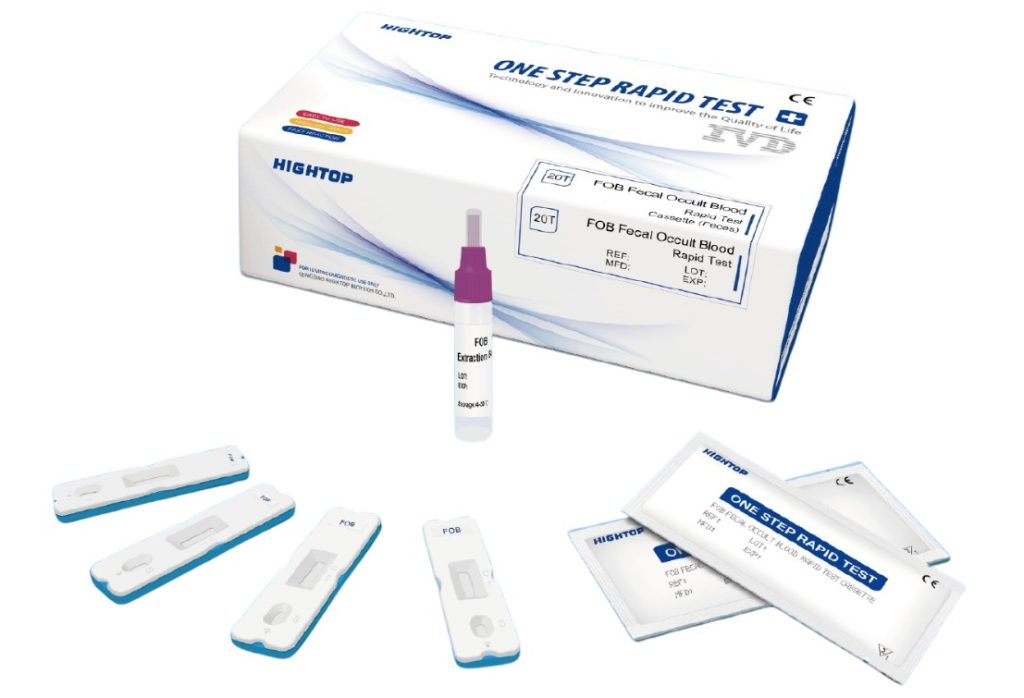
Fecal occult blood 50 ng/ml (FOB 50 ng/ml) test (Cassette) – NS Promedica
Fecal occult blood 100 ng/ml (FOB 100 ng/ml) test (Cassette) – NS Promedica
Why Organizations and Agencies Should Choose the FOB Rapid Test
- Affordable: the cost per kit is low, making it possible to screen large numbers of employees or members within a controlled budget.
- Easy to use, fast results: the steps are simple and anyone can do it themselves, reducing the burden on medical staff.
- Suitable for every organization: ideal for annual health-check programs, employee benefits, government agencies, factories, communities, clinics, and sub-district health-promoting hospitals.
- Enhances a positive image: helps employees and members receive preventive health care, reflecting an organization that cares.
- Convenient for mass screening: screen large numbers of people to identify those who should be referred for detailed testing, using resources efficiently.
You Can Lower Your Risk Yourself
Beyond screening, adjusting your everyday habits genuinely helps reduce the risk of colorectal cancer.
- Add fiber: eat more vegetables, fruit, and high-fiber whole grains.
- Cut red and processed meat: especially processed meats such as sausage, bacon, and ham.
- Get moving: exercise regularly and keep your weight within a healthy range.
- Quit smoking and limit alcohol: both clearly raise the risk of bowel cancer.
- Pay attention to your body’s signals: don’t ignore abnormal symptoms, and get screened according to the recommended age.
Conclusion: Don’t Wait for Symptoms
Colorectal cancer is a serious disease that stays “silent” in its early stage, yet it is also one of the cancers that is most preventable and curable when detected early. A screening test such as the FOB Test takes only a little time and is easy to do. This one small step could change the course of your life—from “found too late” to “found while still curable.”
If you or someone you love is approaching age 50 or has risk factors, don’t wait for symptoms—talk to a doctor about screening today.
Note This article is intended for general knowledge only and cannot replace a diagnosis or advice from a doctor. If you have abnormal symptoms or wish to be screened, consult a medical professional for advice suited to you.